White Paper: Expanding stellar horizons with polarized light
White paper in response to the ESO call Expanding Horizons: What science questions will astronomy need to answer in the 2040s?
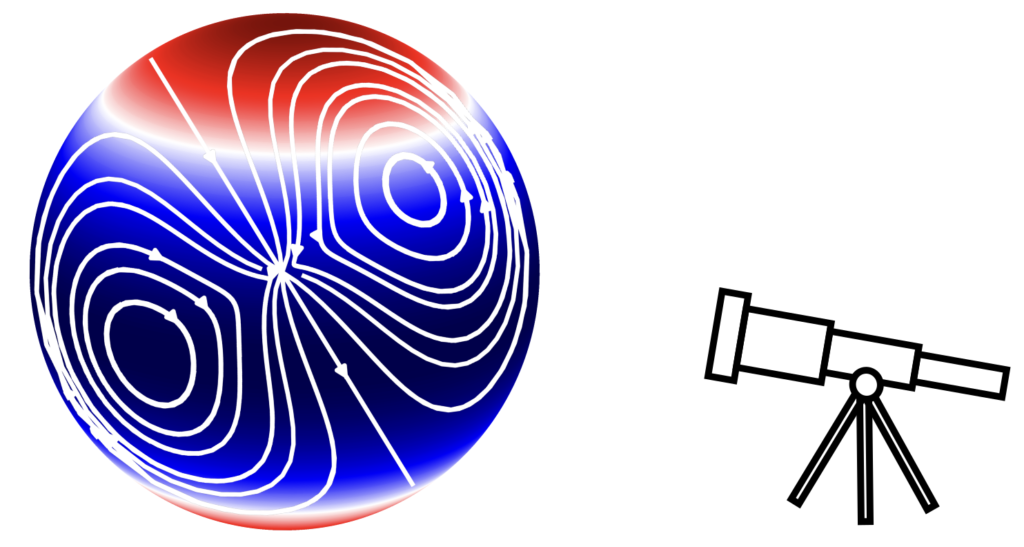
In this white paper, we discuss the science questions and instrumentation we think fundamental in the 2040s. We argue that the polarization of light is a critically under-utilized source of rich information in stellar astronomy. Accessing the polarization for targets throughout the Hertzsprung-Russell diagram will lead to leaps in advancement in our understanding of the surface magnetic fields of stars. This additionally gives the required boundary conditions to constrain the internal magnetic fields of seismically active stars, an aspect of the internal structure that only recently has become accessible to us.
An instrument capable of high-resolution, high-aperture, high-cadence (spectro)polarimetry and spectroscopy opens the door to these surface and internal magnetic fields. The high-cadence spectroscopy and polarimetry are fundamental to access higher order modes and constraining oscillation mode identification, a pillar of accurate asteroseismic modelling of the stellar interiors.
Vandersnickt, J., Ochoa Armenta, R., Vanlaer, V., David-Uraz, A., et al. (2025). Expanding stellar horizons with polarized light. Available on arXiv. (ads)
Asteroseismic detection of an internal magnetic field in the B0.5V pulsator HD 192575

Hidden magnetic fields inside hot blue stars have been an elusive component for a long time. These fields can have a major impact on the angular momentum transport and chemical mixing inside these stars. Our Letter reports a detection of such a hidden field inside the hot blue star HD 192575 using magneto-asteroseismology.
Read the full press release here!
Vandersnickt, J., Vanlaer, V., Vanrespaille, M., Aerts, C. (2025). Asteroseismic detection of an internal magnetic field in the B0.5V pulsator HD 192575. Astronomy & Astrophysics, Volume 704, L13. (ads)
Effects of limited core rejuvenation on the properties of massive contact binaries
When stars are born with two in one system, they can interact with each other. If they approach each other close enough, they can ‘touch’ and they take the form of a peanut, and we call them contact binaries. There are only a handful of such systems detected, but they are incredibly interesting. Currently, we cannot explain their period and mass ratio distribution. In this publication, we focus on those systems with massive companions and limit the mixing near the core to investigate whether this has an effect on the distribution of such massive contact binaries.
Vandersnickt, J., Fabry, M. (2025). Effects of limited core rejuvenation on the properties of massive contact binaries. Astronomy & Astrophysics, Volume 695, A223. (ads)